Whole-home filtration · Worcester County, Maryland

Pocomoke City, Maryland water quality

What the City of Pocomoke City reports, how close each result is to its limit, and what it means for homes on town water or on a private well. One system at the main treats every tap, with no salt, no power and no drain line.

The Pocomoke River waterfront with brick buildings, a marina and the water tower at sunset
The short answer

Pocomoke City's town water comes from wells about 140 feet deep in the Pocomoke aquifer. The City's 2025 report says the water is safe and meets federal and state requirements, and marks no violation for any contaminant result. The results to know are the byproducts: total trihalomethanes reached 64 ppb against an 80 ppb limit (80% of it), and haloacetic acids 34 ppb against 60. The report also lists two lead service line paperwork violations.

If you are on a private well outside the town system, your water can be quite different. USGS sampling of Worcester County wells found iron above the guideline in 86.5% of results, manganese in 73.3%, and hard or harder water in 27.3%. Only a test of your own tap or well will show what is in it.

Source: City of Pocomoke City 2025 Water Quality Report (published 2026), as reported by the City of Pocomoke City. Read on November 7, 2026.

Common problems

Three things people notice around Pocomoke City

Town water

Trihalomethanes near the limit

Pocomoke City's total trihalomethanes reached 64 ppb against an 80 ppb limit, with samples from 8 to 87.2 ppb. The limit is judged on a running average. Chem Guard, the third stage, is built for chlorine taste and for byproducts, and lab results show THMs reduced by 99.93% or more. Read the fine print.

Town water

Chlorine

Pocomoke City disinfects with chlorine, a 1.8 ppm highest result against a 4 ppm limit, with readings from 1.5 to 1.8 ppm. That is the highest chlorine level of the Worcester County towns we read. A carbon-based whole-home filter is designed to reduce chlorine taste and smell.

Private wells

Iron, manganese and hard water

USGS sampling of Worcester County wells found iron above the guideline in 86.5% of results, manganese in 73.3% and hard or harder water in 27.3%. A well needs a different build than a town connection. See the well system.

What it does to a home

Four numbers worth knowing

64 ppb

TTHMs in town water

The highest level against an 80 ppb limit. Samples ran from 8 to 87.2 ppb, and the limit is judged on a running average.

1.8 ppm

Chlorine in town water

Against a 4 ppm limit. It is the reason some tap water smells like a pool.

86.5%

Well iron

Share of Worcester County well results above the 0.3 mg/L guideline. Iron is what stains sinks, tubs and laundry orange.

73.3%

Well manganese

Share of county well results above the 0.05 mg/L guideline. Manganese leaves dark brown or black stains.

Sources: City of Pocomoke City 2025 Water Quality Report (published 2026); USGS Water Quality Portal (Worcester County wells, 1990 to 2023).

The public record

What the City of Pocomoke City reports

These figures come straight from the City's own report, with the legal limit beside each one.

How to read this table
  • Each card is one utility. "What it found" is what its own 2025 report printed. "Legal limit" is the most the law allows. "Compared" tells you which side of the limit the result falls on. Yellow means the result is under the limit but at or above 75% of it.
  • ppm and ppb are tiny amounts. One ppm is one drop in about 13 gallons, and one ppb is a thousand times smaller. Lower is better for most items.
  • Chlorine is added to kill germs. TTHM and HAA5 are byproducts that form when that chlorine meets natural material in the water. Their limits are judged on a yearly average, so one high sample does not break the limit.

City of Pocomoke City

Wells about 140 ft deep in the Pocomoke aquifer

Full report (PDF)

Every result we read in Pocomoke City's report is under its legal limit. The closest is TTHM at 80% of its limit. 2 results are above EWG's stricter health guideline, which is a third-party benchmark and not a legal limit.

7results compared to a limit
2above an EWG health guideline
0over a legal limit
1not detected

Above EWG's health guideline

Each bar counts how many times the result is above EWG's guideline, on a scale that grows tenfold at each tick. The dashed line marks the legal limit on the same scale.

TTHM (chlorine byproduct)

64 ppb highest (samples 8 to 87.2) measured · 0.15 ppb EWG guideline · 80 ppb legal limit · 80% of the legal limit

427×the EWG guideline

Above the EWG guidelineClose to the legal limit

guideline10×100×1,000×10,000×

HAA5 (chlorine byproduct)

34 ppb highest (samples 23.2 to 44.5) measured · 0.1 ppb EWG guideline · 60 ppb legal limit · 57% of the legal limit

340×the EWG guideline

Above the EWG guideline

guideline10×100×1,000×10,000×

Closest to a legal limit

TTHM (chlorine byproduct)

64 ppb highest (samples 8 to 87.2) against a limit of 80 ppb

80%of the limit

Close to the limitTrihalomethanes are judged on a running average, not on single samples. Under the limit, but at or above 75% of it.

HAA5 (chlorine byproduct)

34 ppb highest (samples 23.2 to 44.5) against a limit of 60 ppb

57%of the limit

Under the limit

Chlorine (disinfectant)

1.8 ppm highest (range 1.5 to 1.8) against a limit of 4 ppm

45%of the limit

Under the limit

See every result we read (7)

Chlorine (disinfectant)

1.8 ppm highest (range 1.5 to 1.8) against a limit of 4 ppm

45%of the limit

Under the limit

TTHM (chlorine byproduct)

64 ppb highest (samples 8 to 87.2) against a limit of 80 ppb

80%of the limit

Close to the limitTrihalomethanes are judged on a running average, not on single samples. Under the limit, but at or above 75% of it.

HAA5 (chlorine byproduct)

34 ppb highest (samples 23.2 to 44.5) against a limit of 60 ppb

57%of the limit

Under the limit

Barium

0.0023 ppm (2025) against a limit of 2 ppm

<1%of the limit

Under the limit

Gross beta radiation

4.9 pCi/L (2024) against a limit of 50 pCi/L

10%of the limit

Under the limit

Copper (90th percentile at homes)

0.215 ppm (2021 to 2023) against a limit of 1.3 ppm (action level)

17%of the limit

Under the limit

Lead (90th percentile at homes)

Not detected (2021 to 2023) against a limit of 15 ppb (action level)

0%of the limit

Under the limit

The report lists two lead service line paperwork violations: the initial inventory was due October 16, 2024 and was submitted late, on January 9, 2025, because of the service line investigation. Neither is a lead result.

Source: City of Pocomoke City 2025 Water Quality Report (published 2026). Full report: MDE copy (PDF). Questions go to the City at 410-957-3311.

Lead service line notices

Pocomoke City's report lists two violations that are about paperwork. The initial service line inventory was due to MDE by October 16, 2024. The City says it returned to compliance when it submitted the documents on January 9, 2025, and that the report was late because of its service line investigation. Neither violation is a lead result. Lead tap sampling from 2021 to 2023 was not detected, with no sites over the action level.

DRAFT: Pocomoke City's report was read from a scan, and it does not print hardness. Please approve the lead notice paragraph, and confirm the City phone and the Pocomoke City ZIP (21851) before launch.
A third-party view

What the Environmental Working Group lists

EWG's Tap Water Database republishes utility results reported to the state, then compares them with its own health guidelines. Those guidelines are much stricter than legal limits and are not enforceable, so a listing below is not a violation. EWG's data for Pocomoke City run through 2023, and every contaminant it lists is a disinfection byproduct: it averages total trihalomethanes at 78.6 ppb against the 80 ppb limit and haloacetic acids at 29.8 ppb against 60. Those are older averages than the City's 2025 report above, which prints a highest level of 64 ppb for trihalomethanes.

Source: EWG Tap Water Database, system MD0230006, retrieved 2026-11-05. The byproducts EWG lists are shown against their limits in the City's results above.

Private wells

If you are on a well near Pocomoke City

Homes outside the town system often use private wells. These are results from wells USGS has sampled across Worcester County. They show the range across the county. Your well may differ.

How to read this table
  • Each row asks one question: how many of the water tests from this county's wells went past a guideline? A result such as "40% of results" means about 40 out of every 100 tests.
  • Guidelines for iron, manganese and chloride are about stains, taste and pipes. The limits for nitrate and arsenic are about health.
  • mg/L and ug/L are tiny amounts. A mg/L is one ppm, and a ug/L is one ppb.
  • These are tests from a mix of wells over many years. They show the county's pattern, not your well.

In Worcester County wells, the most common findings are iron (87 in 100 tests) and manganese (73 in 100 tests). For health limits, nitrate was over its limit in 37 in 100 tests (a small sample).

8things checked
2found in half of tests or more
4found in 1 in 10 to 1 in 2 tests
2found in fewer than 1 in 10

Each bar shows how many of the water tests from Worcester County wells went past the guideline or limit. The ticks mark 1 in 4, 1 in 2 and 3 in 4. These are tests from a mix of wells over many years, not a rate for your home.

Iron

Causes orange or brown stains and a metal taste.

87in 100 tests above the 0.3 mg/L guideline

Stains, taste or pipes

none1 in 41 in 23 in 4all

86.5% of results (median 5.2 mg/L). Based on 289 tests at 69 wells.

Manganese

Causes dark brown or black stains.

73in 100 tests above the 0.05 mg/L guideline

Stains, taste or pipes

none1 in 41 in 23 in 4all

73.3% of results. Based on 285 tests at 70 wells.

Nitrate

A health limit. It matters most for infants under six months.

37in 100 tests above the 10 mg/L legal limit

Health limitSmall sample

none1 in 41 in 23 in 4all

37.0% of results. Based on 27 tests at 16 wells (1993 to 2011). Too few tests to call a county rate, which is a good reason to test your own well.

Hard water

Leaves scale on heaters, fixtures and glass.

27in 100 tests hard or harder (over 7 grains per gallon)

Hardness

none1 in 41 in 23 in 4all

Median 5.0 grains per gallon; 27.3% hard or harder (over 7 gpg); 9.7% very hard (over 10.5 gpg). Based on 278 tests at 74 wells.

Acidic water (low pH)

Can corrode pipes and leave blue-green stains.

26in 100 tests with a pH below 6.5

Stains, taste or pipes

none1 in 41 in 23 in 4all

25.7% of results (median pH 6.8). Based on 770 tests at 95 wells.

Sodium

Adds a salty taste and matters on a low-sodium diet.

19in 100 tests above 100 mg/L

Stains, taste or pipes

none1 in 41 in 23 in 4all

19.1% of results. Based on 277 tests at 74 wells.

Salt (chloride)

Gives a salty taste and can corrode pipes.

9in 100 tests above the 250 mg/L guideline

Stains, taste or pipes

none1 in 41 in 23 in 4all

8.9% of results. Based on 471 tests at 82 wells.

Arsenic

A health limit set for drinking water.

0in 100 tests above the 10 ug/L legal limit

Health limitSmall sample

none1 in 41 in 23 in 4all

0% of results. Based on 21 tests at 11 wells. Too few tests to call a county rate, which is a good reason to test your own well.

Source: USGS Water Quality Portal, Worcester County wells sampled 1990 to 2023. Maryland tests a private well only when it is built, so the only way to know your own well is to test it.

Drinking water

If your well water is acidic

In USGS sampling of Worcester County wells, 25.7% of results had a pH below 6.5. Pure Way Vital is our answer at the drinking tap. It goes under the sink on the cold water line, with no drilling and no extra faucet. Its Vital Balance stage neutralizes acidic water and adds minerals including calcium and magnesium. In Pure Way's measured performance, pH rises by about 2 points, with roughly 50 TDS of added natural minerals and a neutral ORP. The result is mineral-based drinking water at a normal to alkaline pH, not extreme pH levels or chemical manipulation.

Vital comes in two versions. DUO (Chem Guard and Vital Balance) adds to a home that already has the whole-house system. TRIO (Nano Armor, Chem Guard and Vital Balance) is a stand-alone under-sink system. Neither needs electricity, tanks or pressurization.

Vital treats the drinking water at one faucet. It does not treat the whole house, so it does not change the water reaching your pipes, water heater or fixtures. Figures are approximate and come from Pure Way's Vital product literature. Results vary with your source water.

One system

From the main to every tap

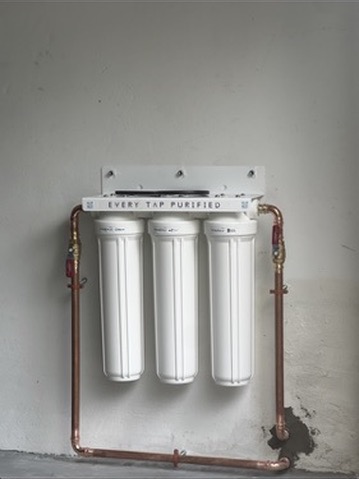
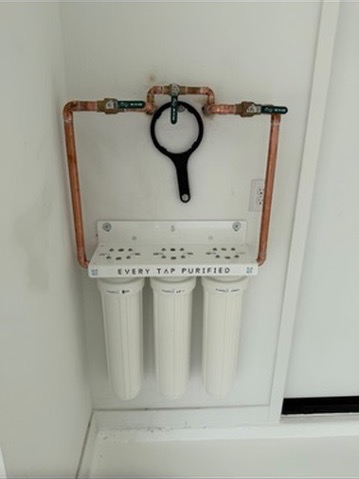
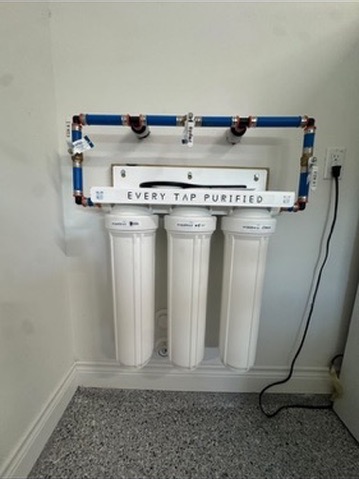
The Pure Way system goes in where the water main enters your house. Three housings, in order, and every tap gets the same filtered water. No salt, no power, no drain line.

DRAFT: the animated stage tour and the stage carousel go here. They are built as shared components, once, and reused on every page.
Stage 1

Pure Shield

A pleated cartridge that catches sediment, rust flakes and charged particles first, so they never reach the finer stages. Its Siliphos media is designed to condition calcium and magnesium so they stay dissolved and less reactive. The minerals stay in your water, and no salt or added sodium is involved.

Stage 2

Nano Armor

A physical barrier with pores measured in nanometers. It holds ultra-fine particles that slipped past stage one, and it keeps flow strong because it does not have the pressure drop of a membrane system.

Stage 3

Chem Guard

Specialty activated carbon that works on chlorine, chloramine and the disinfection byproducts that affect taste and smell. It also supports reducing lead. This is the stage where most people notice the change at the tap.

Each housing holds one cartridge. They last between 18 and 36 months, depending on water usage and quality. You can change them yourself, or we can come out and do it for a service fee. Well water usually needs extra components first, such as a sediment screen or an iron filter. See the well build. Select components are certified by IAPMO R&T to NSF/ANSI 42, 61 and 372. Pure Way is not the certification holder. Actual performance varies with source water, installation, flow rate and maintenance.

Does my softener already do this?

A salt softener and a Pure Way system handle scale differently

A softener is built for one thing: hardness. Pocomoke City's report does not print a hardness figure, and Worcester County wells are moderately hard in places, and a softener does that job. The table shows what it does not cover.

What it doesSalt softenerPure Way municipal system
Hard water scaleRemoves hardness minerals by swapping them for sodiumStrong anti-scale and softening-type effect: the media bonds with the minerals so they cling less to pipes, fixtures and heaters
MineralsSwapped for sodiumStay in the water, conditioned. Not every mineral is removed
Chlorine taste and odorNot what it is built for99.1% reduced in lab testing
ChloramineNot what it is built for99.6% reduced
Disinfection byproducts (THMs, HAA5, HAA9)Not what it is built forTHMs 99.93% or more, HAAs 98.7% or more
PFOA, PFOS and four other PFASNot what it is built for99.3% or more reduced
LeadNot what it is built for99.92% or more reduced

Pure Way figures are independent laboratory challenge results for the municipal three-stage system, measured early in the filter's life (BCS Laboratories, March to May 2026). They are not a guarantee for any home. Read the full table and fine print on the lab results page.

What to expect from a Pure Way system

A Pure Way system is not a true, salt-based softener, and it does not strip every mineral out of the water the way one does. It was built to handle scale a different way, and on town water it has strong softening properties. It does not remove everything, though: on town water the three-stage system on its own does not remove sodium, fluoride, iron, manganese, nitrate or arsenic, and we have add-ons that take care of any of them. Chloride and sodium are not removed by the Pure Way three-filter system, so a salty taste calls for a test first. Results vary with your source water, installation and upkeep.

What an install looks like

Three housings on one wall

DRAFT: these photos are small and not from the Eastern Shore. Higher-resolution originals and local installs are better, and an owner photo with a short intro belongs here too.
Local

The local Pure Way distributor

Pure Way Eastern Shore serves Talbot, Dorchester, Caroline, Queen Anne's, Wicomico and Worcester counties. We do not run a storefront. We come to your home, test your water and, if you decide to go ahead, install the system and handle the cartridge changes.

The City of Pocomoke City serves the city (ZIP 21851). Homes just outside it are often on private wells. Call the City at 410-957-3311 to confirm your address.

  1. Check your water. Read the numbers on this page, or call and we will tell you what your water source is.
  2. Book a free test. We test the water at your kitchen tap. For wells, we take a sample to a certified lab and walk you through the report.
  3. Decide with the readings in hand. No obligation, and no pressure to buy.
Free water test

See what is in your water before you decide anything.

We test the water at your tap, in your home, at no cost. Tell us where you are and what kind of water you have, and we will call you to set a time. No obligation.

Rather talk now? Call (410) 431-0822.

Step 1 of 3

What is your ZIP code?

Questions

Pocomoke City water questions

Is Pocomoke City water safe to drink?

The City of Pocomoke City's 2025 report says its drinking water is safe and meets federal and state requirements, and marks no violation for any contaminant result. It draws from wells about 140 feet deep in the Pocomoke aquifer. Chlorine was 1.8 ppm against a 4 ppm limit, total trihalomethanes 64 ppb against 80, and haloacetic acids 34 ppb against 60. The report also lists two lead service line paperwork violations. Only a test of your own tap shows what reaches your home.

Does Pocomoke City have high trihalomethanes?

The report prints a highest total trihalomethanes level of 64 ppb, with samples from 8 to 87.2 ppb, against an 80 ppb limit that applies to a running average. That is 80% of the limit. Haloacetic acids reached 34 ppb against a 60 ppb limit. Chem Guard, the third Pure Way stage, is built for byproducts.

What lead service line violation does Pocomoke City list?

The report lists two paperwork violations for the initial service line inventory that was due to MDE by October 16, 2024. The City says it returned to compliance when it submitted the documents on January 9, 2025, and that the report was late because of its service line investigation. It is not a lead result, and lead tap sampling from 2021 to 2023 was not detected.

Is Pocomoke City water hard?

The City's report does not print a hardness figure, so we can't state one for town water. For private wells in Worcester County, USGS sampling found a median of 5.0 grains per gallon, with 27.3% of results hard or harder and 9.7% very hard. A free in-home test reads the hardness at your own tap.

Why is well water near Pocomoke City orange or stained?

Orange or rust-colored stains usually point to iron. In USGS sampling of Worcester County wells, 86.5% of iron results were above the 0.3 mg/L guideline, with a median of 5.2 mg/L, and 73.3% of manganese results were above 0.05 mg/L. A test of your own well is the only way to know what yours contains, and a well needs a different build than a town connection.

Call