Private wells · Maryland's Eastern Shore

Well water filtration for Maryland's Eastern Shore

A private well has no treatment plant and no yearly report. What comes out of your tap depends on the ground around the well, so we build a system from standard components and add what your lab report calls for.

The short answer

A well system is a line of components in the order your water meets them, starting at the pressure tank. A spin-down sediment filter goes first. An iron filter goes next if your water needs it. Then comes the three-filter stage, a scale conditioner and UV disinfection, with reverse osmosis at the kitchen tap when arsenic or nitrate is the concern. Each part protects the ones after it, and the lab report decides what goes in.

Wells here often carry iron, manganese, salt or acidic water, and some carry nitrate.

Common well water issues

What is in your well? Where does it come from?

A private well has no treatment plant and no yearly report. What comes out of the tap depends on the sand and clay under the lot, the land around the well, and the well itself.

The numbers on the drawing show where each issue starts. Use the arrows to step through all nine, or select a number to read about one. You can also scroll straight past it.

1 of 12
01 to 05

From the rock and soil

These start underground, in the sand and gravel the well draws from and in the water heater at the end of the line.

01

Hard water

You notice it
You notice
White scale on faucets and in the water heater, spots on glass, and soap that will not lather.
Where it comes from
Calcium and magnesium dissolve from the sand and shell the water moves through. The more it touches, the harder it gets.

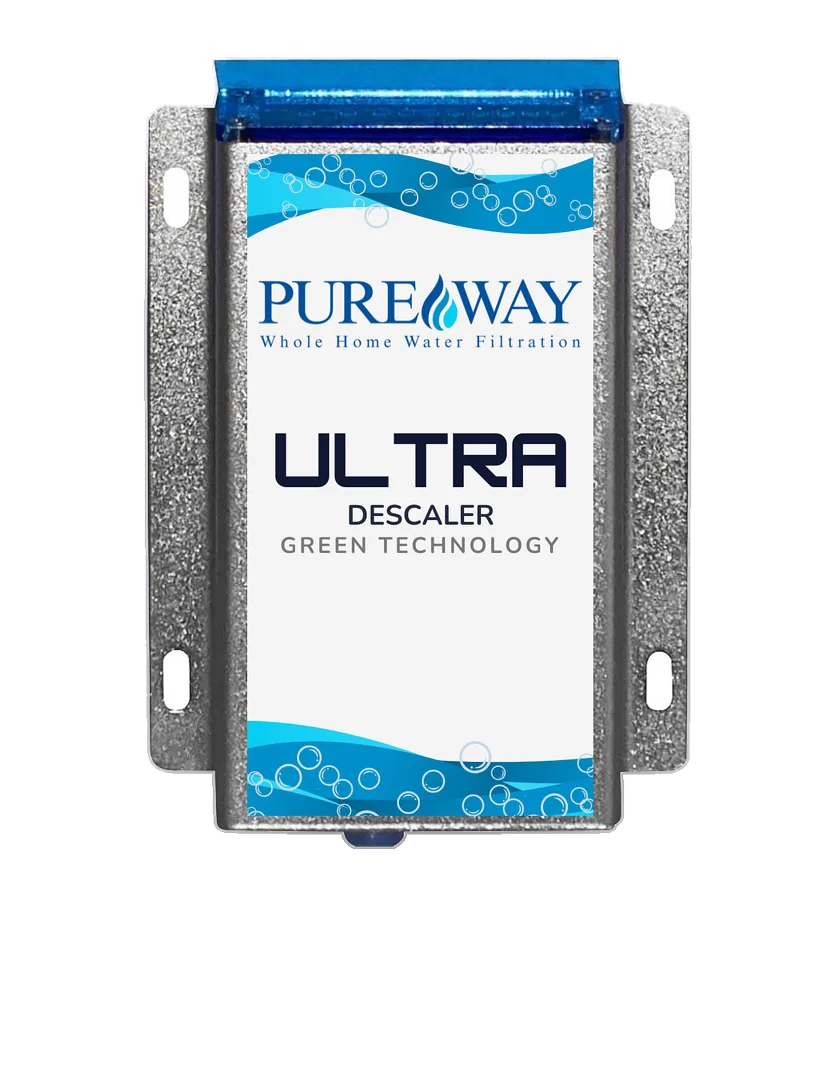
Best handled by Pure Shield and the Ultra Descaler keep the hardness minerals from turning into scale. The minerals stay in the water, but they bond far less with pipes, fixtures and the water heater. Neither is a salt softener.

02

Iron

You notice it
You notice
Orange or rust stains in sinks, tubs and laundry, and a metallic taste.
Where it comes from
Iron dissolves out of the sediments as water moves underground. It turns to rust the moment it meets air.

Best handled by The UltraShield Iron Filter, where a well needs one, catches it ahead of the fine filters. It needs an outlet and a drain line.

03

Manganese

You notice it
You notice
Black or dark brown stains, and dark flecks in the water.
Where it comes from
Another mineral in the sediments, and it usually travels with iron.

Best handled by The UltraShield Iron Filter, where a well needs one, takes out manganese along with the iron.

04

Rotten-egg smell

You notice it
You notice
A rotten-egg smell, often strongest from the hot tap.
Where it comes from
Sulfur bacteria in the groundwater make hydrogen sulfide gas. When only the hot water smells, the water heater is usually part of the story.

Best handled by The UltraShield Iron Filter, where a well needs one, helps with a sulfur smell, and Chem Guard works on taste and odor. A lab test shows what is behind it.

05

Arsenic

Lab test only
You notice
Nothing. You cannot see, smell or taste it.
Where it comes from
It occurs naturally in some of the sediments the water passes through. The EPA standard is 10 micrograms per liter.

Best handled by The UltraShield Iron Filter lists arsenic among what it removes, and Ultrasafe RO at the kitchen tap is the add-on for drinking and cooking water.

06 to 09

From the well and the land around it

These come in through the well itself, from the farms and septic systems nearby, or from the rain.

06

Sand and sediment

You notice it
You notice
Grit in the glass, clogged faucet screens, and cloudy water after the pump runs.
Where it comes from
Fine sand enters through the well screen, especially in loose Coastal Plain sand, and more so when a screen is old or damaged.

Best handled by The Spin-Down Sediment Filter goes first and flushes itself clean. The Ultra Membrane stage in the 3-Filter Well System takes the finer sediment behind it.

07

Bacteria

Lab test only
You notice
Usually nothing. Clear, good-tasting water can still carry bacteria.
Where it comes from
Surface water and runoff get in through a cracked cap or casing. A nearby septic system or a flood can add more.

Best handled by The UVC Disinfector treats the water for bacteria. A lab test tells you whether you have a bacteria problem at all.

08

Nitrate

Lab test only
You notice
Nothing. It has no color, taste or smell, and it matters most for infants.
Where it comes from
Fertilizer, manure and septic systems. Sandy soil lets it reach the water table quickly, and the farms and poultry houses here make it a local concern.

Best handled by Ultrasafe RO at the kitchen tap is the add-on for nitrate, for drinking and cooking water.

09

Acidic water

You notice it
You notice
Blue-green stains around drains, pinhole leaks in copper, and a metallic taste.
Where it comes from
Rain is slightly acidic, and Coastal Plain sand has little in it to neutralize that. The water can reach your well still acidic.

Best handled by Pure Way Vital raises the pH of your drinking water at one faucet. What the rest of the house needs depends on your lab report.

That is the whole picture

A lab test tells you which of these your well has

Most wells have a few of these and not the rest. The system below is built in the order the water meets each part.

See the well system

This drawing shows how each issue gets into a well and which part of the system works on it. Which of them your well has depends on your lot, and only a test of your own water shows that.

The well build

From your well to every tap

One well has sand. The next has iron or a sulfur smell, and many have hard water. These are the components we use most, in the order the water flows through them. A sample build is a starting point, and your lab report decides the real one.

01 · First stop for sediment

Spin-Down Sediment Filter

StandardNo power

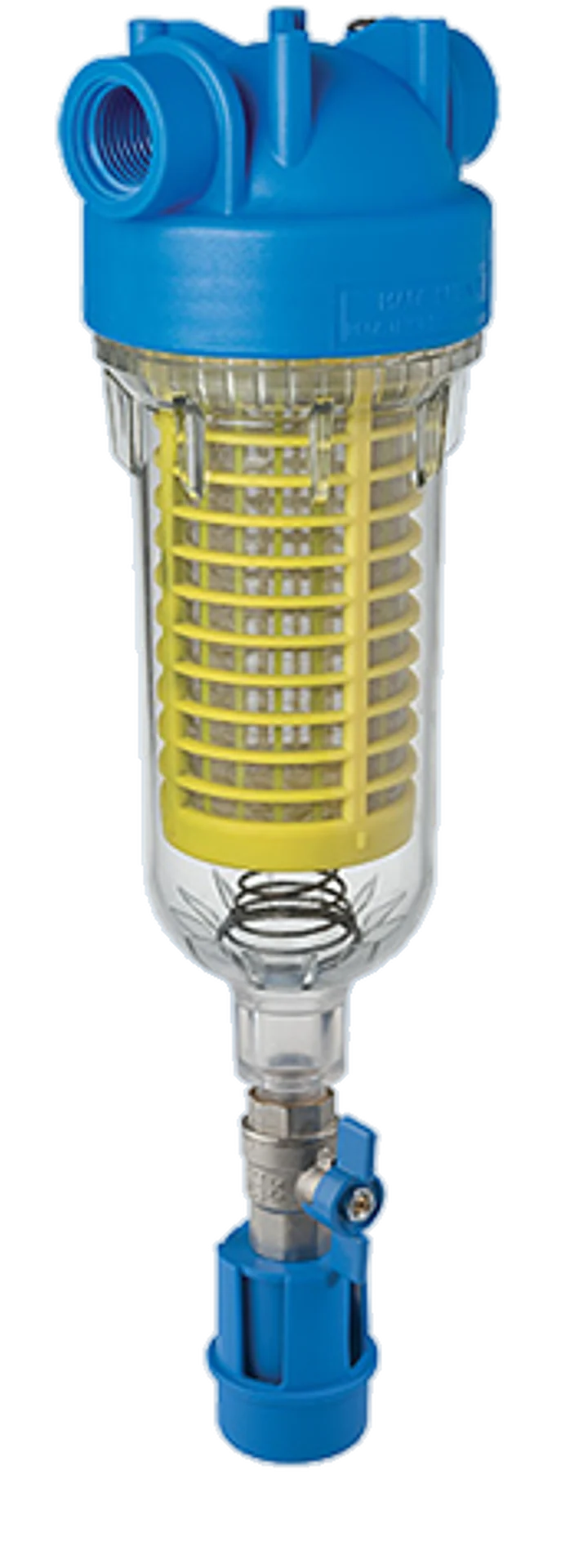
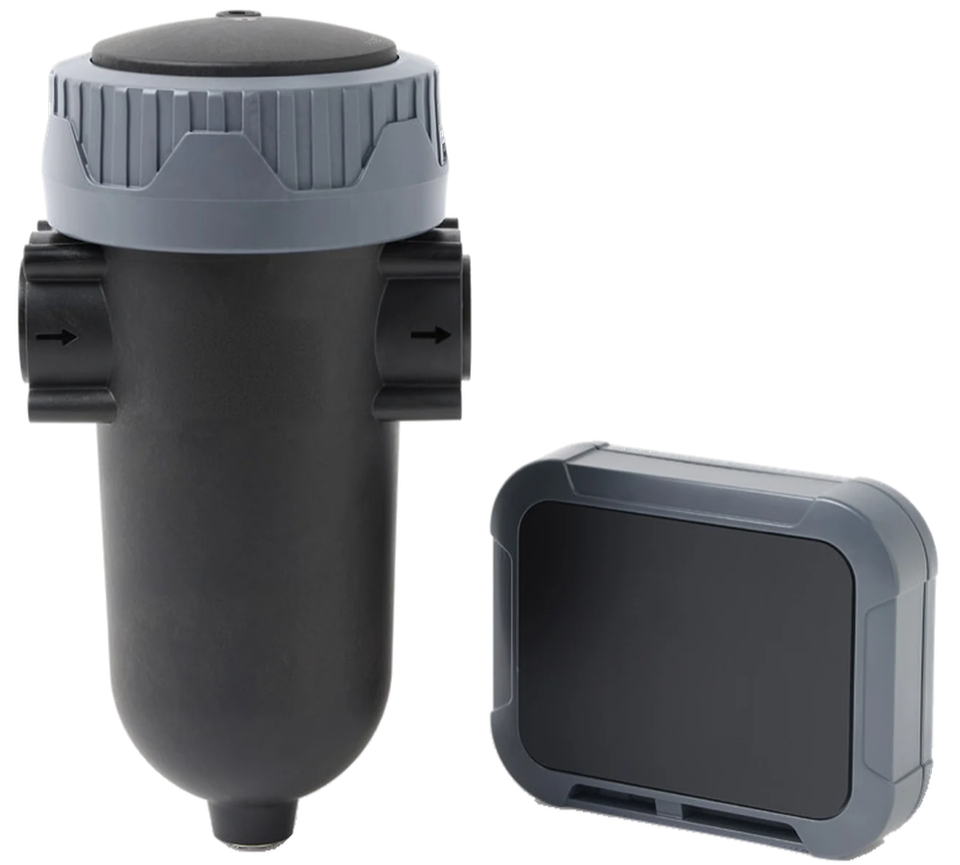
The UltraPre Filter is a self-cleaning sediment filter for the sand, scale and grit that come up from a well. Open the drain valve and it flushes itself clean from the inside of the cartridge out. One cartridge lasts for years, because you flush it instead of replacing it.

50 or 90 micron · up to 40 gpm · up to 125 psi

Works onSand and sediment

How it works and what it needs
02 · Catches iron before the filters

UltraShield Iron Filter

If neededOutlet and drain line

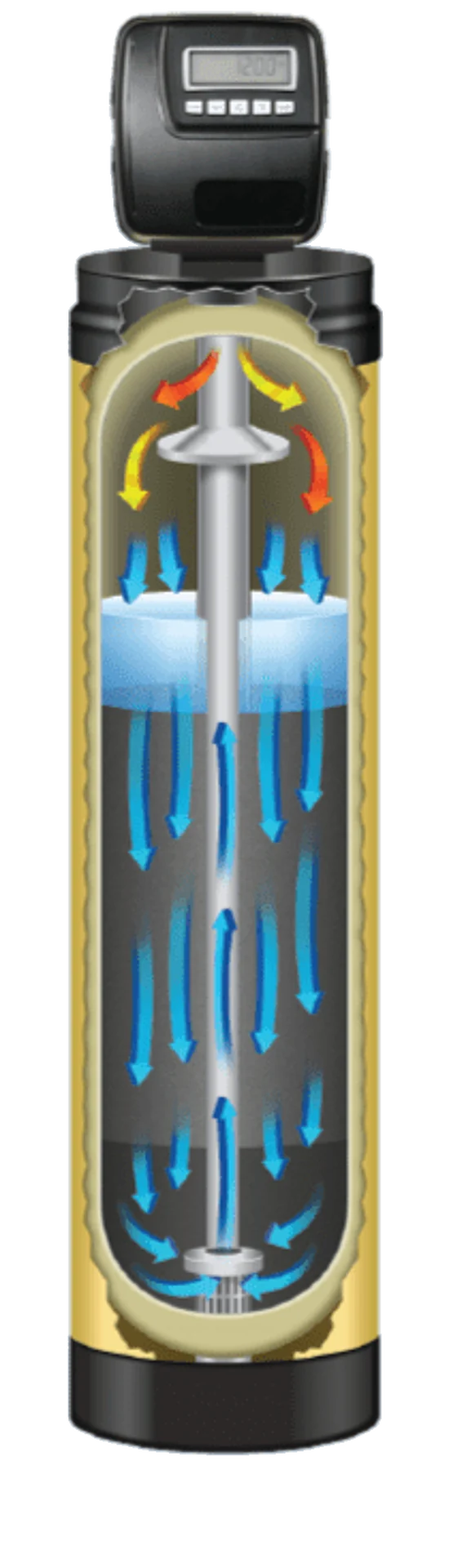
The UltraShield goes in when a well has iron, manganese, a sulfur smell or arsenic. A pocket of compressed air inside the tank turns them into particles that catalytic media catches, and on a schedule the tank backwashes them out and draws in fresh air. A built-in ozone generator cleans the media each cycle, with no chemicals. It meets the Water Quality Association's Gold Seal standards, and it needs an outlet and a drain line.

10 x 54 tank · up to 21 gpm · up to 4 baths

Works onIronManganeseSulfur smellArsenic

How it works and what it needs
03 · Whole-home filtration for wells

3-Filter Well System

Standard

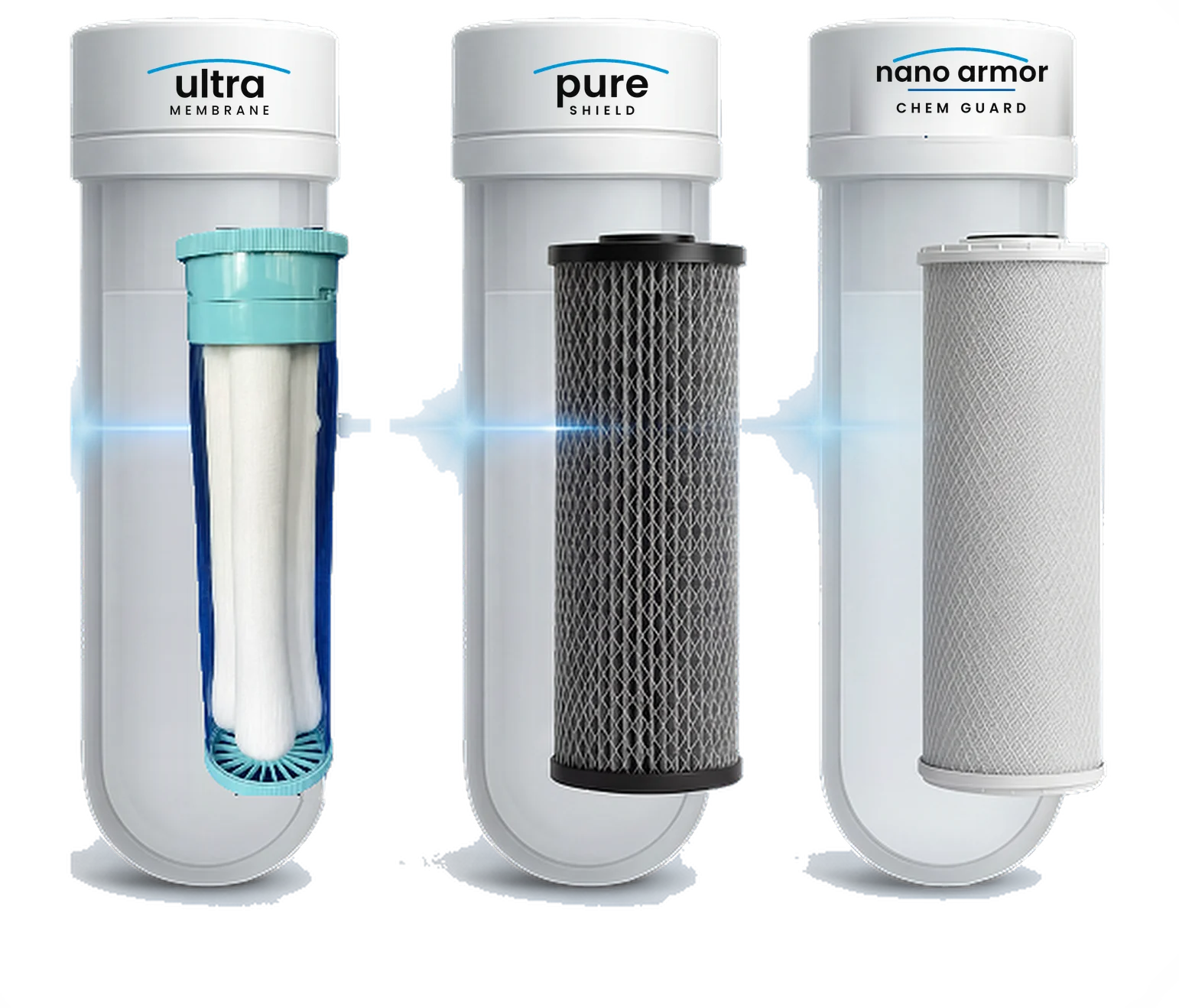
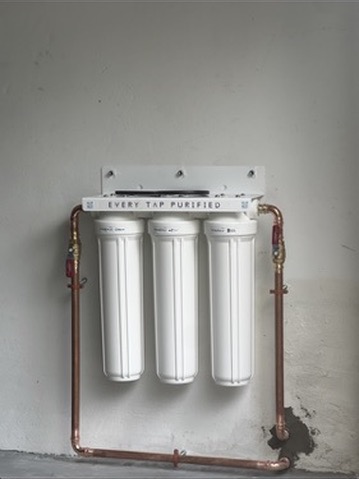
Three housings in a row. The Ultra Membrane takes out the fine, cloudy sediment that gets past the spin-down, then Pure Shield catches sediment and charged particles, and Nano Armor with Chem Guard holds ultra-fine particles and works on chlorine, taste and odor.

Works onFine particlesChlorineTaste and odor

How it works and what it needs
04 · Keeps hardness from scaling

Ultra Descaler

Standard

The Ultra Descaler goes on the main line. A control box sends a changing signal through a wire coiled around the pipe, designed to reduce scale in the water heater and the dishwasher. It needs an outlet and is not a salt softener. The UltraSafe SP3 does the same job another way: crystallization media turns hardness into tiny crystals that stay in the water, with no salt, power or backwashing.

SP3: 12, 16 or 22 gpm · up to 2, 4 or 6 baths

Works onScale from hard water

How it works and what it needs
05 · Treats the water for bacteria

UVC Disinfector

StandardPower connection

A polished stainless-steel reactor with a UV lamp that treats the water for bacteria and viruses, including E. coli, Cryptosporidium and Giardia. It goes last, right before the house plumbing, and it tracks lamp life with an audible and visual alarm. It needs a power connection, and the lamp swaps in a quarter turn.

6, 11, 15 or 21 gpm · 9,000 hour lamp

Works onBacteria

How it works and what it needs
06 · Drinking and cooking water

Ultrasafe RO

If neededKitchen tap

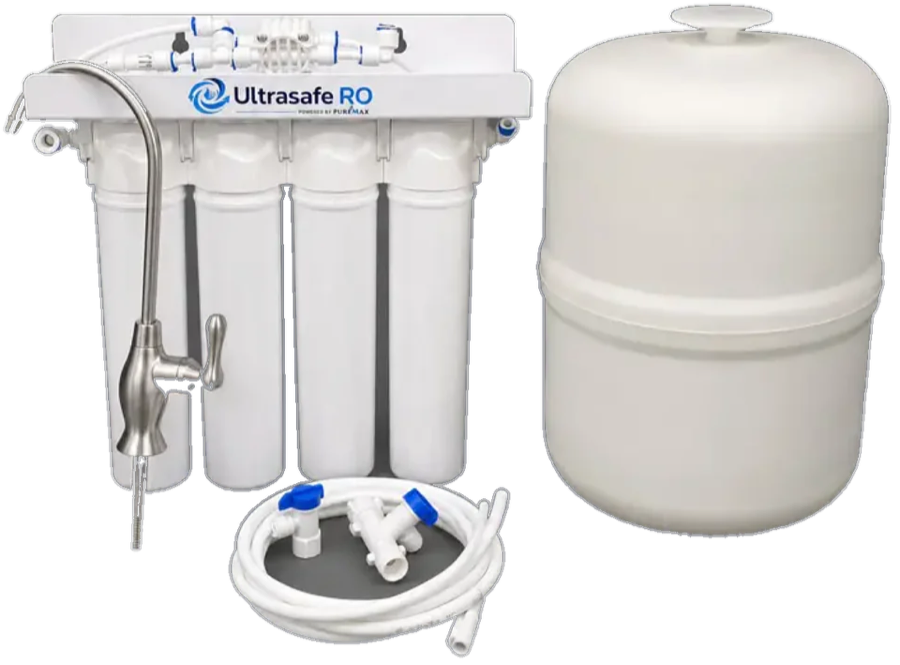
The add-on for arsenic and nitrate, and it also reduces fluoride and salts. It treats the water at the kitchen tap for drinking and cooking, up to 50 gallons a day, and can feed a refrigerator or ice maker too. A final alkaline stage raises the pH. Filters are changed at least yearly and the membrane every 36 months.

50 gallons a day · five stages · needs a drain line

Works onArsenicNitrateFluorideSalts

How it works and what it needs
Out to the house

Every tap runs on treated water

The UV lamp is the last stop before the house plumbing, so every tap and the water heater run on treated water. When a kitchen tap is added, it gets its own line.

Treated water toKitchenBathroomsLaundryWater heater

1 of 8
How each component works

What every part does, and what it needs

Components marked "if needed" go in only when your water calls for them. A sample build is a starting point for the conversation, and your lab report decides the real one.

Standard

1. Spin-down sediment filter

The first stop for sand and sediment from the well. It needs no power.

If needed

2. Iron filter

Catches iron and manganese, and helps with a sulfur smell, before the fine filters. Unlike the town-water system, this part needs an outlet and a drain line.

Standard

3. Three-filter stage

A membrane stage, Pure Shield and Nano Armor with Chem Guard, for fine particles, taste and odor and organic chemicals.

Standard

4. Scale conditioner

Ultra Descaler. A control box on the main line sends a changing signal through a wire coiled around the pipe, designed to reduce scale in the water heater and the dishwasher. It needs an outlet and is not a salt softener.

Standard

5. UV disinfection

A UV lamp treats the water for bacteria. Unlike the town-water system, this part uses a power connection.

If needed

6. Reverse osmosis at the kitchen tap

The add-on for arsenic and nitrate, for drinking and cooking water only.

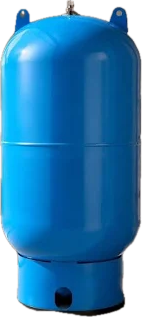
A pressure tank sits upstream of the system, and a water softener is optional. The well version is built from standard components matched to your lab report. The independent lab results are for the town-water system. Select components are certified by IAPMO R&T to NSF/ANSI standards 42, 61 and 372, and Pure Way is not the certification holder.

A sample well water build, from the well to every tapCutaway of a drilled well and a house. A submersible pump in the well sends water to the basement, where it passes the pressure tank, a sediment filter, an iron filter if needed, the three-filter stage, a scale conditioner and UV disinfection. The filtered water runs up to the kitchen, where a reverse osmosis tap can be added if needed.DRILLED WELLWATER TABLESUBMERSIBLEPUMPAQUIFERPRESSURETANKSPIN-DOWNFILTERULTRASHIELDIRON FILTER, IF NEEDED3-FILTER WELLSYSTEMULTRADESCALERUVCDISINFECTORULTRASAFE ROKITCHEN TAP, IF NEEDED

Swipe sideways to see the whole diagram.

DRAFT: please confirm the component order, which parts need power and a drain line, and the UV and reverse osmosis wording for Eastern Shore builds. Also confirm the nine issue cards (the Coastal Plain wording, the poultry and tidal creek scenery, and what the iron filter treats), and whether a whole-house fix for acidic water is offered.
What Eastern Shore wells show

The most common findings, county by county

These are results from wells USGS has sampled across each county. They show the pattern, not your well, and each county page has the full list and the town-by-town water reports.

CountyMost common findings in well tests (in 100 tests)
Talbot Countynitrate 38 in 100 (small sample), hard water 35 in 100, arsenic 30 in 100 (small sample)
Dorchester Countysodium 53 in 100, manganese 51 in 100, acidic water 49 in 100
Caroline Countyacidic water 65 in 100, nitrate 36 in 100 (small sample), manganese 19 in 100
Queen Anne's Countymanganese 52 in 100, nitrate 47 in 100, iron 47 in 100
Wicomico Countyacidic water 93 in 100, manganese 56 in 100, iron 44 in 100
Worcester Countyiron 87 in 100, manganese 73 in 100, nitrate 37 in 100 (small sample)
Drinking water

If your well water is acidic

Acidic water is common in several counties' wells, including Wicomico and Caroline. Pure Way Vital is our answer at the drinking tap. It goes under the sink on the cold water line, with no drilling and no extra faucet. Its Vital Balance stage neutralizes acidic water and adds minerals including calcium and magnesium. In Pure Way's measured performance, pH rises by about 2 points, with roughly 50 TDS of added natural minerals and a neutral ORP. The result is mineral-based drinking water at a normal to alkaline pH, not extreme pH levels or chemical manipulation.

Vital comes in two versions. DUO (Chem Guard and Vital Balance) adds to a home that already has the whole-house system. TRIO (Nano Armor, Chem Guard and Vital Balance) is a stand-alone under-sink system. Neither needs electricity, tanks or pressurization.

Vital treats the drinking water at one faucet. It does not treat the whole house, so it does not change the water reaching your pipes, water heater or fixtures. Figures are approximate and come from Pure Way's Vital product literature. Results vary with your source water.

Testing

Why a lab test comes first

Every well is different, and the water can differ from one lot to the next. Maryland tests a private well only when it is built, so unless you test it, nobody does. The free visit tests the water at your tap, measures the flow and looks at the equipment, and on most wells we take a sample to a certified lab. The lab report is what shows what is in the water, and it decides what your system needs.

Not sure whether you are on a well or a town system? Your water bill and your town office usually settle it. Book a free well consultation and we will help.

What an install looks like

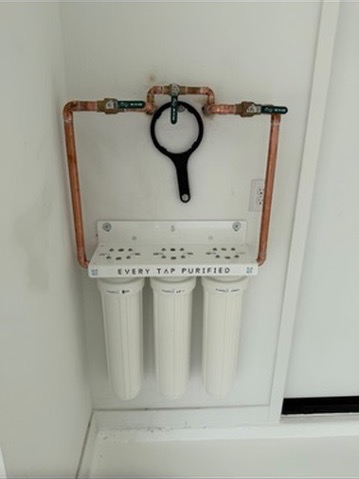
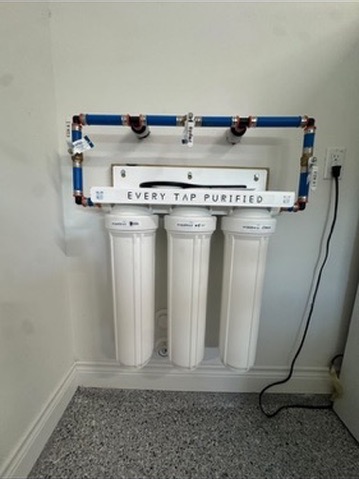
Three housings on one wall

DRAFT: these photos are small and not from the Eastern Shore. Higher-resolution originals and local installs are better, and an owner photo with a short intro belongs here too.
Free water test

See what is in your water before you decide anything.

We test the water at your tap, in your home, at no cost. Tell us where you are and what kind of water you have, and we will call you to set a time. No obligation.

Rather talk now? Call (410) 431-0822.

Step 1 of 3

What is your ZIP code?

Questions

Well water questions

How often should a private well be tested?

Health agencies commonly recommend testing a private well at least once a year for bacteria and nitrate, and testing again after a flood, a repair or any change in taste, color or smell. Maryland tests a private well only when it is first built, so after that the testing is up to you.

Can I tell what is in my well by looking at the water?

Only for some things. Iron and manganese stain, hydrogen sulfide smells, and hardness leaves scale. Arsenic, nitrate and bacteria give no sign at all, so a clear, good-tasting well can still need a lab test.

Is the free visit the same as a lab test?

No. The free visit tests the water at your tap, measures the flow and looks at the equipment. Most wells also need a lab test before we build, because the lab report is what shows what is in the water.

Will a well system remove arsenic and nitrate?

Yes. Reverse osmosis at the kitchen tap is the add-on for arsenic and nitrate, for drinking and cooking water. A lab test comes first, so the build matches what is actually in your water.

Do the lab results on this site apply to a well system?

The independent lab results on this site are for the town-water three-stage system. A well build is made from standard components matched to your lab report, and a lab retest after the build confirms how it is working.

What should I do if my well tests positive for coliform bacteria?

Do not drink the water until it has been retested and treated, and contact your county health department for guidance. A UV disinfection stage is a standard part of a well build, and a lab retest after the build confirms it is working.

Call